In 2026, content discovery is shifting fast. People aren’t just relying on traditional search engines, and more and more they ask AI assistants like ChatGPT, Google Gemini or Perplexity AI for answers. If your iGaming brand isn’t optimized for these systems, you risk losing visibility AND sales. On the other hand, if you prepare your content correctly, you may capture new audiences even before they click on traditional search results.
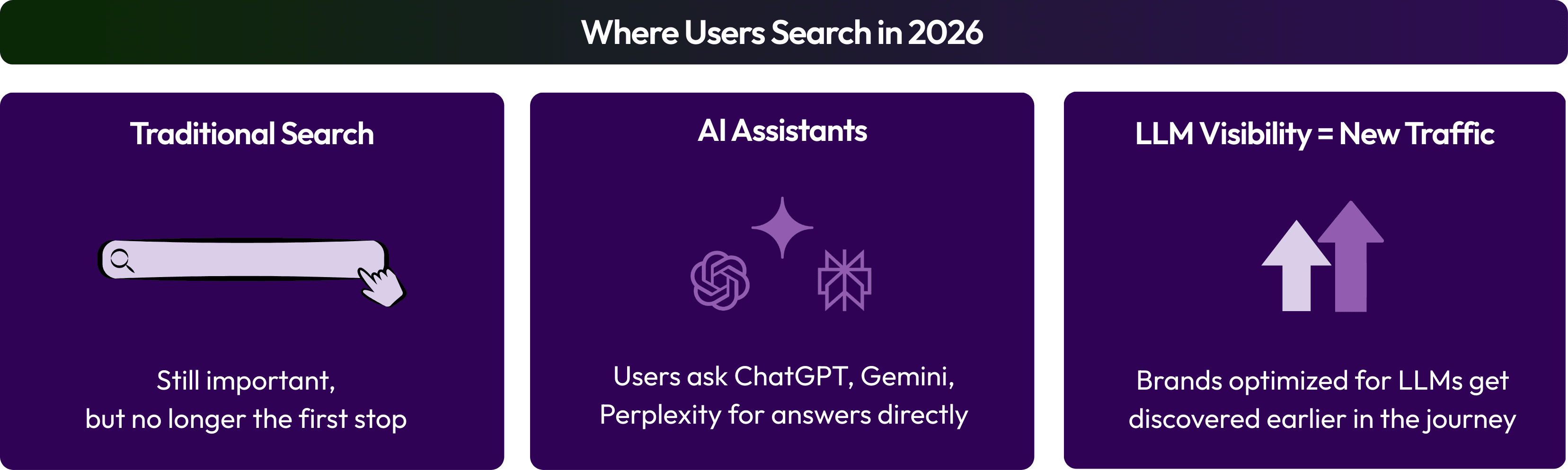
Here’s a guide for iGaming companies to get their content ready for LLM-powered search in 2026. I outline key principles, concrete steps, and show why ignoring LLM-friendly content could cost you.
Why optimizing for LLMs matters, and what’s changing
The old model of SEO served link-based search results: you optimised for keywords, built backlinks, and aimed for page 1 on Google or Bing. But in 2025–2026, that’s no longer enough.
- AI-driven assistants increasingly provide direct answers, not link lists. As a result, many users now get what they need without ever clicking, what’s known as “zero-click” results;
- For industries like iGaming (where traffic, player leads, and conversions depend heavily on visibility) this shift is critical. If your content doesn’t register as a credible source for AI assistants, you may lose out to competitors who do;
- Optimizing for AI-assisted discovery is already becoming standard. Strategies like Generative Engine Optimization (GEO) or more broadly Answer Engine Optimization (AEO) are emerging as essential for brands aiming for longevity.
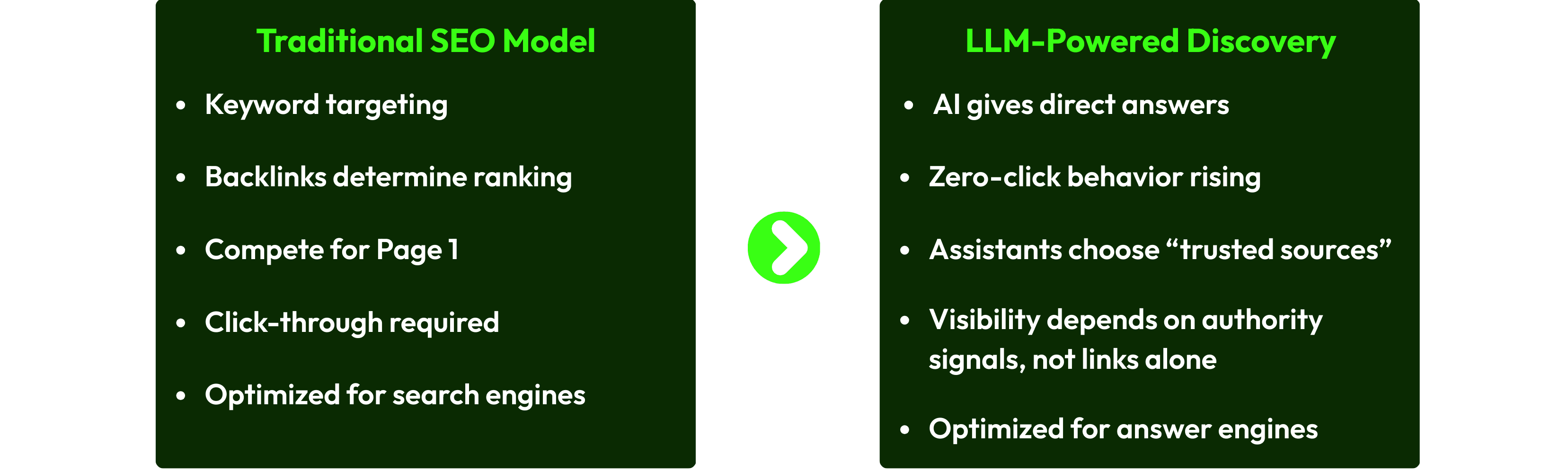
In short: traditional SEO still matters. But if you don’t adapt to AI-powered content discovery, you risk becoming invisible to a growing portion of users.
What LLMs and AI assistants look for when deciding what to show
Understanding how AI assistants “choose” sources helps you design content that gets picked up. Several patterns emerge from recent research and case studies.
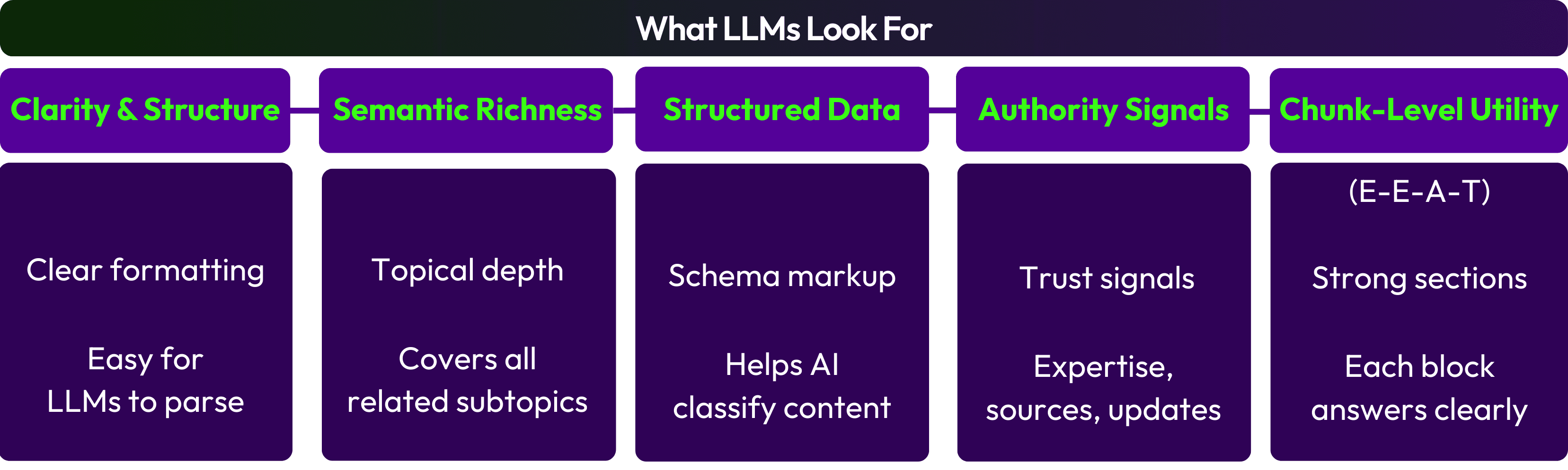
Key Signals
- Clarity and structure: LLMs favour content that’s well-organized, easy to parse, with clear headings, sub-headings, and self-contained sections;
- Semantic richness and topical depth: Instead of just repeating a keyword, content should cover a topic thoroughly, using related terms, synonyms, and covering subtopics. That helps an AI “understand” context;
- Structured data / metadata: Schema markup (e.g. Article, FAQ, How-To) helps AI tools and crawlers understand what type of content is on the page;
- Authority and trust signals (E-E-A-T): Expertise, author credentials, up-to-date data, transparent sourcing — all contribute to the AI seeing the page as credible;
- Chunk-level utility: Instead of optimizing the page in total, optimize individual sections (“chunks”) so each can answer a specific question on its own. LLMs often extract and cite content at section or paragraph level.
What this means for content
You need to think of each of your articles or pages not as a long narrative, but as a set of self-contained information units. Each section should be able to stand alone and answer a clear question or explain a clear concept.
If you do that well, AI assistants may quote or summarise just those sections giving you visibility even if your page isn’t ranking #1 in traditional search.
Specific Considerations for iGaming Companies
The iGaming vertical has its own challenges and opportunities when it comes to LLM / AI-SEO.
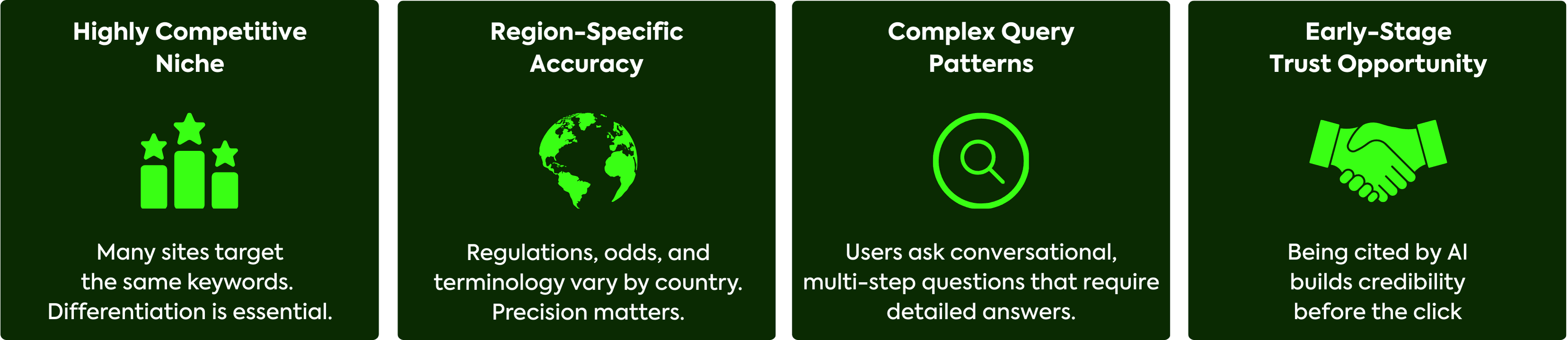
- The niche is highly competitive, many sites target the same keywords (casino reviews, bonus codes, game guides). This makes differentiation crucial. Generic content is rarely enough;
- iGaming content often involves region-specific regulations, odds, game rules, and local terminology. LLM-friendly content needs to be precise, up-to-date, and region-aware. That aligns with E-E-A-T requirements;
- AI-assisted search users may ask types of questions that differ from traditional search. For example: “Which casino has the best poker bonus in 2026 for Portuguese players?” or “What are the fastest payout casinos in EU?” LLM-optimized content can serve those directly;
- For affiliate sites or operators, being cited by AI can translate into early-stage trust building even before a user clicks. That can influence conversion funnel in a powerful way.
Because of all this, iGaming companies that don’t optimize for LLMs risk losing conversions, not just clicks.
A Step-by-Step Guide to Optimize iGaming Content for LLMs
Here’s a practical guide you can apply to your iGaming SEO strategy to take advantage of AI-driven search:

- Review high-performing pages and ad-hoc content. Check if they have clear headings, self-contained sections, and semantic depth;
- Identify thin content, overly generic pages, or pages with vague structure. These are weak from an LLM-optimization perspective;
- Check for metadata and schema markup. If missing, mark pages that need markup updates (Article, FAQ, How-To, etc.).

When creating or rewriting content, treat each logical section as a standalone answer unit. For example:
- Use headings that correspond to actual user questions (What is X? How to do Y? Why Z matters?);
- Keep each section concise but complete, with enough context so that an LLM could quote it without needing other parts of the page;
- Use semantic variation: vary terms, use synonyms, cover related subtopics, link internally to related content.

Implement schema markup relevant to each page:
- For guides or how-tos → use How-To schema;
- For articles → use Article schema;
- For pages with FAQs → use FAQ schema.
This helps AI-driven crawlers parse and understand your content more easily.

Because AI assistants value credibility and up-to-date info, you should:
- Include author bylines, credentials, internal/external references where appropriate;
- Use up-to-date data, numbers, regulations - especially important for iGaming where laws, bonuses, offers change often;
- Regularly review and refresh content (every 3–6 months is a good cadence) to stay relevant.

Rather than random pages, build a content network around core iGaming topics. Use interlinking to help AI understand topical authority.

Perform AI visibility audits regularly:
- Use queries with major AI assistants (ChatGPT with browsing, Gemini, Perplexity) and see if your domain gets cited for relevant queries;
- Compare performance of pages before and after optimization. Track whether AI citations appear, and what kind of content gets picked.
Example: What Good LLM-Ready iGaming Content Looks Like
Below is a minimalist infographic summarizing key differences between traditional SEO content vs LLM-optimized content tailored for iGaming sites.
Traditional SEO vs LLM-Optimized Content
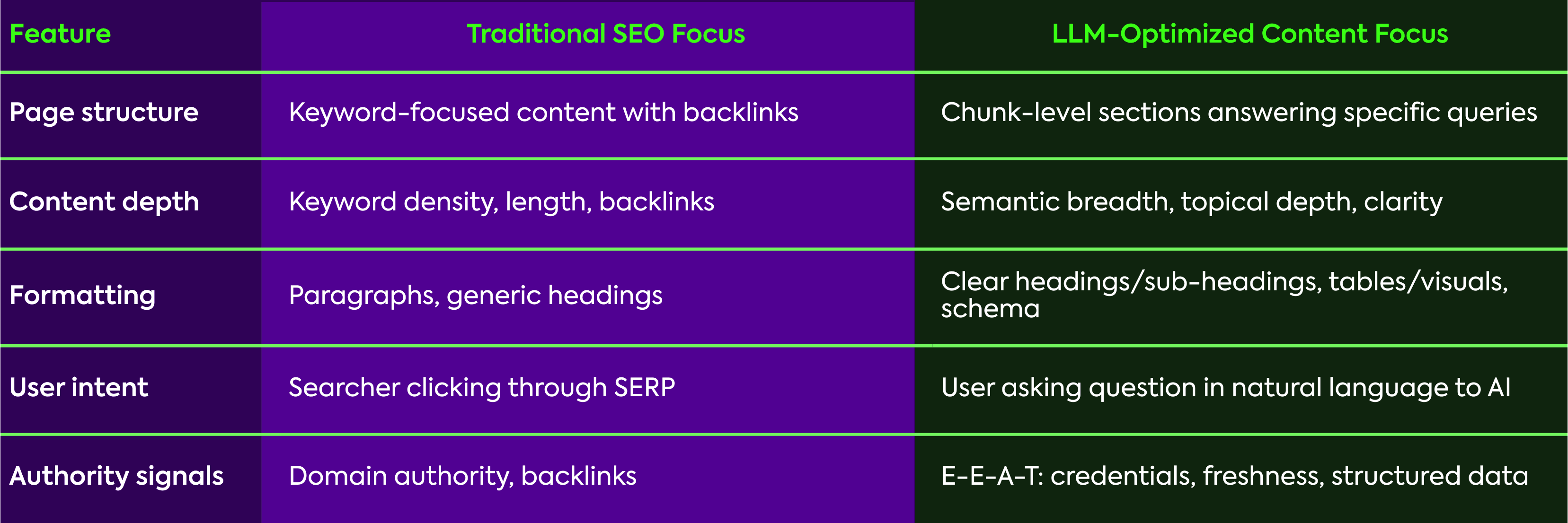
Above you see why thinking only in terms of traditional SEO often leaves a gap. Machines and humans consume content differently.
Measuring Risk: What Happens If You Ignore LLM Optimization
Here’s a simple chart estimating the possible traffic and visibility decline for an iGaming brand that relies solely on traditional SEO, versus one that embraces AI-optimized content.
Best Practices Checklist for iGaming LLM-SEO (Your Actionable To-Do)
Here’s a checklist to help you implement LLM-driven optimization across your iGaming content:
- Audit your existing content for structure, depth, and schema markup;
- Re-write key pages using chunk-level organization: each section answers a clear question;
- Use rich formatting (headings, subheadings, tables, visuals, infographics) to help readability and machine parsing;
- Add structured data / schema (Article, FAQ, How-To) where relevant;
- Include E-E-A-T signals: author info, date, credentials, references;
- Build internal linking and content clusters around core topics (casino reviews, how-tos, regulation guides);
- Update content regularly: refresh data, offers, legal info, etc;
- Monitor AI visibility: run sample queries on ChatGPT, Gemini, Perplexity and see if you get cited. Iterate based on what works.

LLM-based search is no longer a fringe trend. It’s already reshaping how people discover information online. For iGaming companies, where competition is fierce and customer trust matters, ignoring AI optimization isn’t just risky, it may cost you tangible sales, leads, and visibility.
By reworking your content strategy with chunk-level structure, schema markup, semantic depth, and regular updates, you give your brand a shot at being cited by AI assistants. That can translate into early-stage trust, higher engagement, and new channels of traffic even before a user clicks on a traditional search result.