Understanding Link Equity Distribution at Scale

Link equity, often called 'link juice,' represents the authority and ranking power that flows through your website's internal link structure. For enterprise websites, managing this flow becomes exponentially more complex as your page count grows. Every page on your site has a certain amount of authority, derived from external backlinks and internal connections, that it can pass along to other pages through hyperlinks. The challenge lies in distributing this equity strategically to ensure your most important pages receive the authority they need to rank competitively.
Research from multiple enterprise SEO case studies demonstrates the tangible impact of optimized link equity distribution. One retail enterprise saw 150,000 additional annual visits after implementing a strategic internal linking project. Another e-commerce brand experienced a 24% increase in organic traffic by adding deeper internal links from high-authority category pages to product pages buried in their site structure. These aren't isolated incidents, they represent a fundamental principle of enterprise SEO: controlled link equity flow directly influences ranking performance.
The mechanics of link equity distribution follow predictable patterns. Pages closer to your homepage typically receive more authority because they're easier for search engines to discover and usually have more internal links pointing to them. As you move deeper into your site structure, level three, four, or five pages, authority naturally diminishes. For enterprise sites, this creates a critical problem: valuable content buried deep in your architecture may never rank, regardless of its quality, simply because it doesn't receive sufficient link equity.
Strategic internal linking solves this by creating intentional pathways that channel authority from high-performing pages to priority targets throughout your site.
The Hub and Spoke Architecture Model
The hub and spoke model represents one of the most effective enterprise internal linking strategies. This architecture organizes content into thematic clusters, with each cluster centered around a comprehensive 'hub' page that targets a broad, high-volume keyword. Radiating from this hub are multiple 'spoke' pages, each addressing a specific subtopic and targeting long-tail keyword variations. The power of this model lies in its structural clarity. Search engines can easily understand topic relationships, recognize expertise depth, and reward the entire cluster with improved rankings.
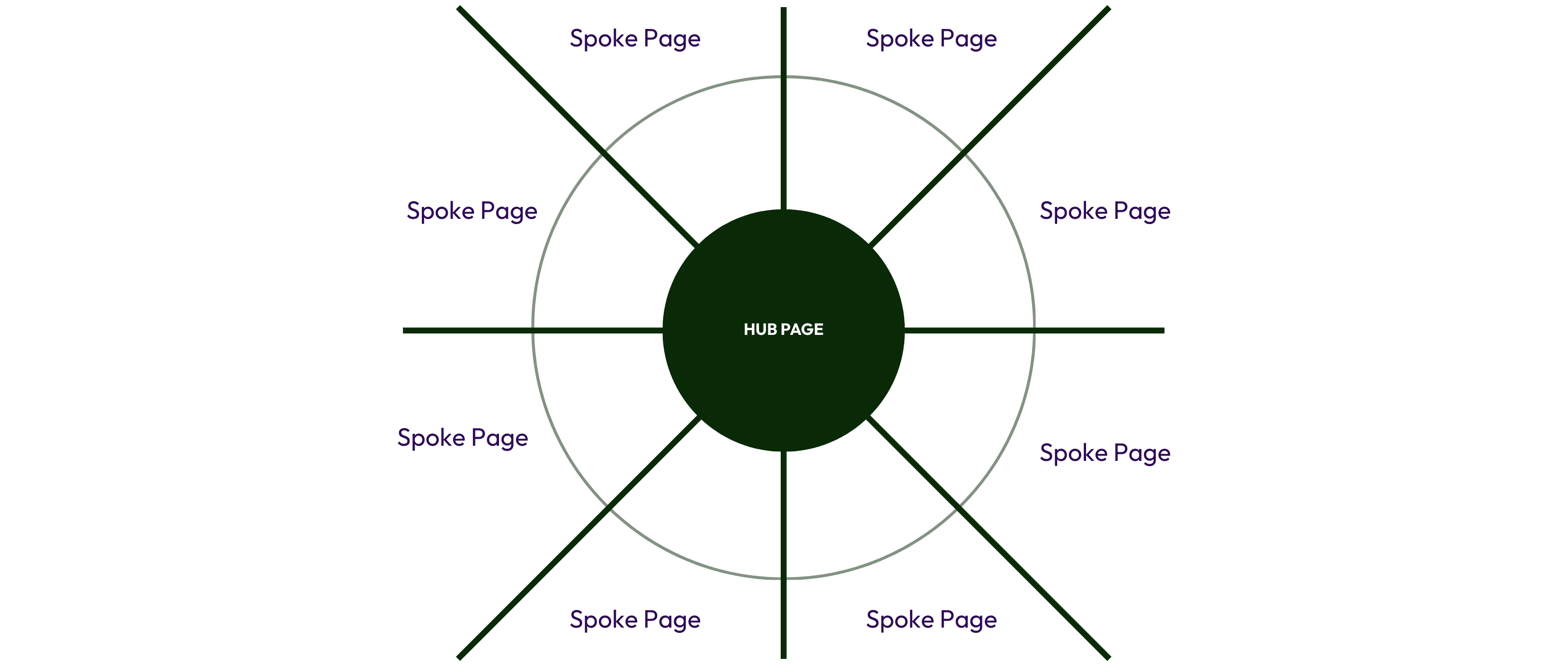
Hub and spoke model showing how content clusters organize around central pillar pages
When properly implemented, the hub page typically ranks for competitive head terms while spoke pages capture long-tail traffic, creating a comprehensive keyword coverage strategy. Implementation requires careful planning. Start by identifying your core topics, these become your hubs. For an enterprise selling marketing software, hubs might include 'Email Marketing Automation,' 'SEO Tools,' or 'Social Media Management.' Each hub needs supporting spokes that dive deeper: 'Email Segmentation Strategies,' 'A/B Testing for Email Campaigns,' or 'Email Deliverability Optimization.'
The internal linking structure follows specific rules. Every spoke page links back to its hub using descriptive anchor text that includes relevant keywords. The hub page links out to all its spokes, providing context and a clear navigation path. Where topically relevant, spokes link to each other, creating a robust web of related content. This cross-linking reinforces relationships and distributes authority throughout the cluster.
Topic clusters built on the hub and spoke model deliver measurable results. Case studies show traffic increases of 156% to pillar pages after implementing cluster strategies, with downstream effects improving rankings across the entire content group. The model also future-proofs your content against algorithm updates by demonstrating comprehensive topical coverage, a key ranking factor in modern search.
Strategic Link Equity Flow Management
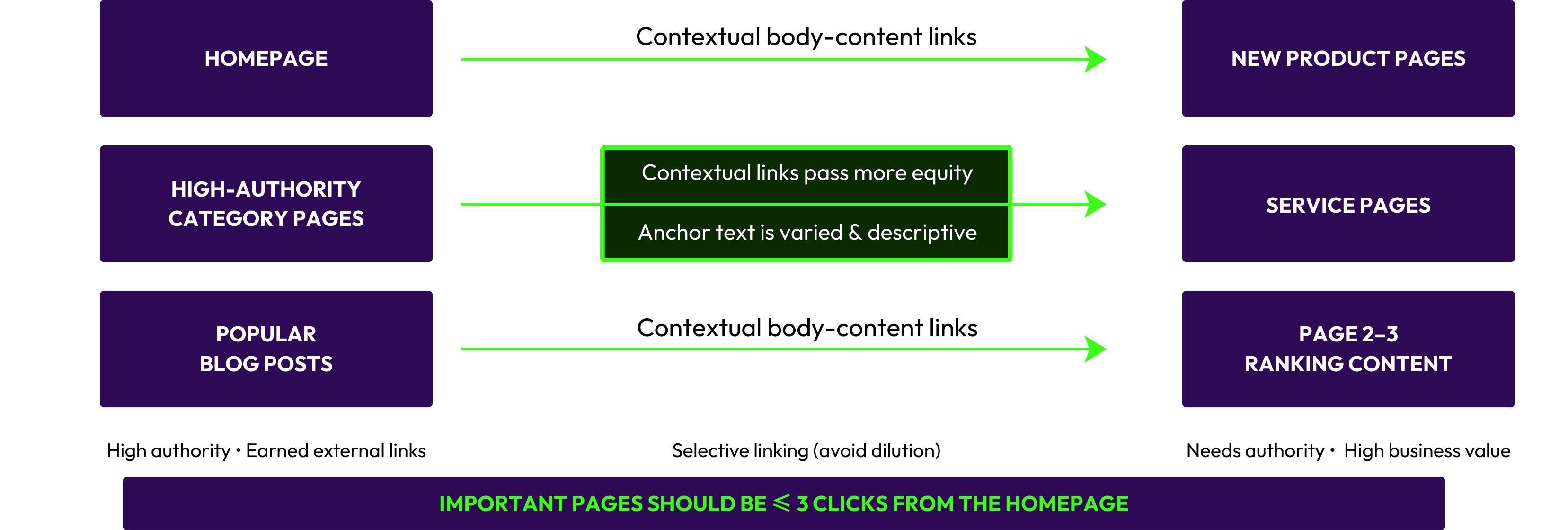
Managing link equity flow at enterprise scale requires understanding which pages hold authority and which pages need it most. This strategic distribution process, sometimes called PageRank sculpting, involves directing your site's collective authority toward pages with the highest business value or ranking potential.
Authority assessment begins with identification. Use tools like Ahrefs, Moz, or SEMrush to identify your highest-authority pages, typically these include your homepage, popular blog posts with substantial backlinks, and category pages that have earned external links over time. These pages become your equity sources. Next, identify target pages, the ones that need authority boosts. These might be new product pages you want to rank quickly, service pages targeting competitive keywords, or content pieces with high conversion potential but currently ranking on page two or three. The gap between their current performance and desired performance indicates how much equity support they need.
The linking strategy connects sources to targets through contextual internal links. Place these links within body content rather than navigation elements, as contextual links carry more weight. Use descriptive anchor text that includes target keywords but avoid exact-match repetition, varied anchor text performs better and appears more natural. A single exact-match anchor from a high-authority page can provide a noticeable ranking boost, according to studies on internal anchor text impact.
Maintain a shallow site architecture where important pages sit no more than three clicks from your homepage. This ensures search engine crawlers reach valuable pages quickly and that link equity doesn't dissipate across too many levels. Pages buried six or seven levels deep receive minimal authority regardless of how many links point to them, because crawl frequency and link flow diminish with depth.
The number of outbound links on a page matters significantly. If a high-authority page links to ten other pages, each receives one-tenth of the distributable equity. If it links to fifty pages, each receives less. This dilution effect means selective linking from your most authoritative pages yields better results than indiscriminate linking.
Implementing Internal Linking Automation
For enterprise websites with thousands of pages, manual internal linking becomes impossible. Automation provides the only scalable solution, but it requires careful implementation to maintain quality and relevance. Several automated internal linking tools have emerged specifically for enterprise needs, including platforms like Quattr, LinkStorm, and seoClarity's Link Seeker. These tools use natural language processing and machine learning to scan your content, identify semantic relationships, and suggest relevant internal links at scale.
The automation process follows a systematic approach:
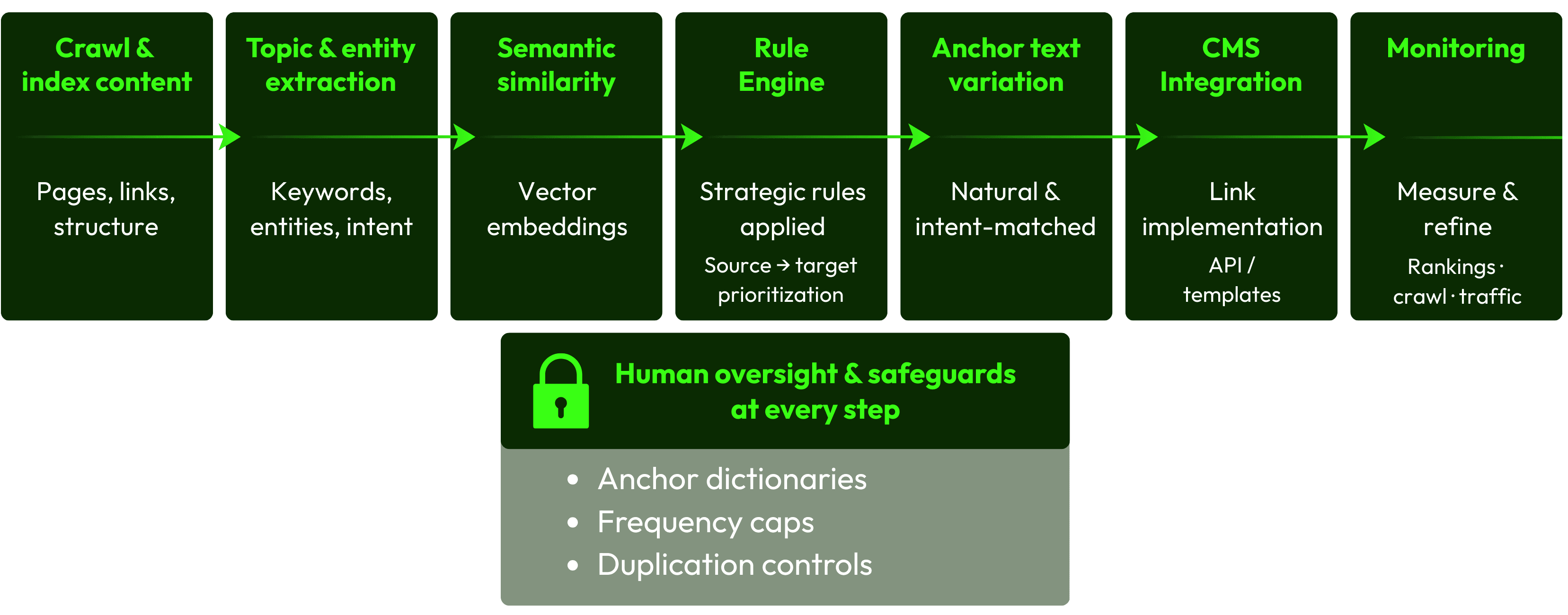
- Conduct a comprehensive site crawl to index all existing content and analyze current internal link patterns
- Use natural language processing to extract topics, entities, and keywords from each page's content
- Generate vector embeddings to measure semantic similarity between pages and identify contextually relevant linking opportunities
- Apply strategic rules that prioritize high-authority pages as sources and business-critical pages as targets
- Create varied anchor text options that match search intent and avoid over-optimization
- Implement links through your CMS API or template modifications, ensuring they integrate naturally into existing content
- Monitor performance metrics to validate that automated links are driving measurable improvements
Automation works best when combined with human oversight. Establish anchor text dictionaries that define preferred phrases, variant options, and disallowed combinations for your key topics. Set frequency caps to prevent any single page from receiving too many links from the same source. Implement duplication controls to avoid creating multiple identical links between the same two pages.
Stage your automation rollout in phases. Start with a controlled test on a subset of pages, perhaps one content category or product line. Measure impact on rankings, organic traffic, and crawl efficiency before expanding. This phased approach lets you refine your rules and catch unintended patterns before they scale across your entire site.
The most sophisticated enterprise implementations integrate automation with existing workflows. When content creators publish new pages, the automation system immediately identifies relevant internal linking opportunities and either suggests links for approval or implements them automatically based on confidence scores. This ensures new content integrates into your link architecture from day one rather than remaining orphaned.
Measuring Internal Linking Performance
Without measurement, you're flying blind. Enterprise internal linking strategies require rigorous tracking of specific KPIs that indicate whether your efforts are delivering results. The timeline for seeing results extends over weeks and months rather than days. As you implement internal links, search engines need time to discover them, re-crawl affected pages, reprocess link signals, and adjust rankings.
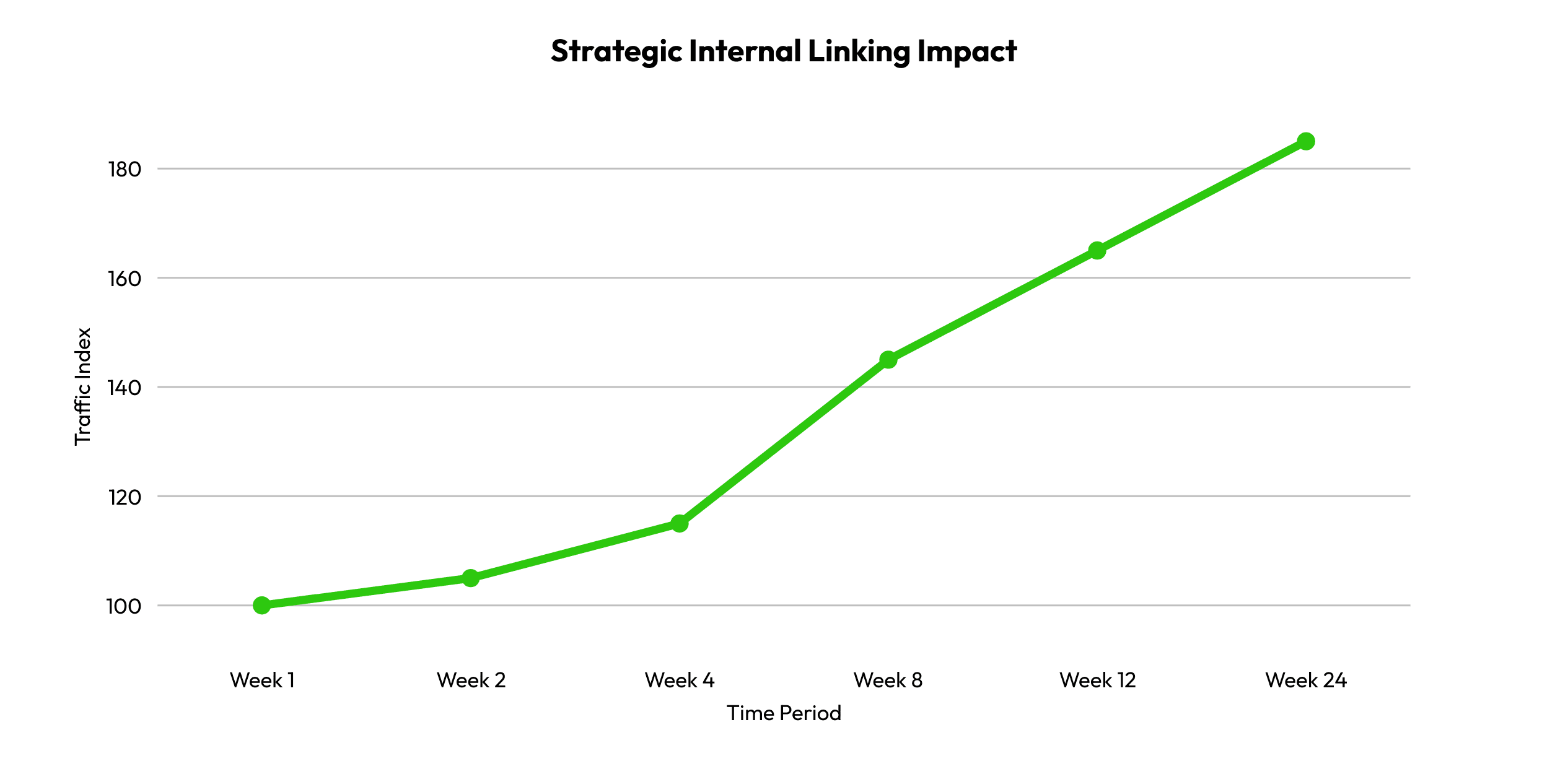
The chart above illustrates a typical realistic projection based on aggregated patterns observed across multiple documented enterprise case studies. This projection reflects the common trajectory reported by implementations using strategies outlined in this guide. Real-world case studies show varied timelines: InLinks documented a 440% increase in impressions and 52% increase in clicks achieved within 3 months on a specific cluster. seoClarity case studies report a retail brand achieving 150,000 additional annual visits through strategic internal linking, while another e-commerce brand experienced 24% organic traffic growth by optimizing link distribution across site architecture levels. A marketplace platform discovered a 100% jump in discovered keywords after implementing automated internal linking for previously orphaned content. These results demonstrate that while individual timelines vary based on site size, industry, and baseline optimization, consistent month-over-month improvement is typical when strategic internal linking is properly implemented.
Crawl depth represents one of the most revealing metrics. Track how many pages search engine bots discover and index within a typical crawl session. As you improve internal linking, you should see increases in discovered pages and reduced crawl depth meaning important pages become accessible in fewer clicks from your homepage. Monitor this through Google Search Console's Crawl Stats report.
Indexation rate indicates how effectively search engines are discovering and indexing your content. Calculate this by dividing your indexed pages (from Search Console) by your total crawlable pages. Enterprise sites with optimized internal linking structures average 90% indexation rates, compared to 60-70% for sites with poor internal link architecture.
Pages per session and session duration reveal whether internal links are successfully guiding users through your content. When users click internal links to explore related pages, both metrics improve. Track these in Google Analytics, segmenting by traffic source to isolate organic search behavior.
Keyword discovery measures the expansion of your rankings. As internal linking improves, you should rank for more keyword variations related to your target topics.
Conversion rate tracking demonstrates business impact. Configure goal tracking in Google Analytics or Google Tag Manager to measure whether users who follow internal links are more likely to convert. Strategic internal linking often guides users from informational content to conversion-optimized pages, creating measurable downstream effects.
Advanced Tactics for Enterprise Scale

Beyond fundamental internal linking strategies, enterprise sites can leverage advanced tactics that deliver competitive advantages:
- Dynamic linking based on user behavior patterns: Implement systems that adjust internal links based on actual user navigation patterns, click-through rates, and conversion paths. Pages that users frequently visit in sequence should be linked together, while underperforming links can be automatically pruned.
- Crawl log analysis integration: Analyze server logs to identify which pages Google crawls most frequently and use this data to inform linking decisions. Direct crawl budget toward high-value pages by increasing internal links from frequently crawled pages to priority targets.
- Seasonal link adjustment: For e-commerce sites with seasonal products or content sites with timely topics, implement automated link adjustments that promote relevant content during peak seasons and deprioritize it during off-seasons.
- Competitive gap linking: Use competitive analysis tools to identify topics where competitors rank but you don't. Create content to fill these gaps and aggressively interlink these new pages with relevant existing content to accelerate rankings.
- AI-powered semantic linking: Deploy machine learning models that understand semantic relationships beyond simple keyword matching. These systems can identify non-obvious connections between topics that create valuable linking opportunities human editors might miss.
Overcoming Common Enterprise Challenges
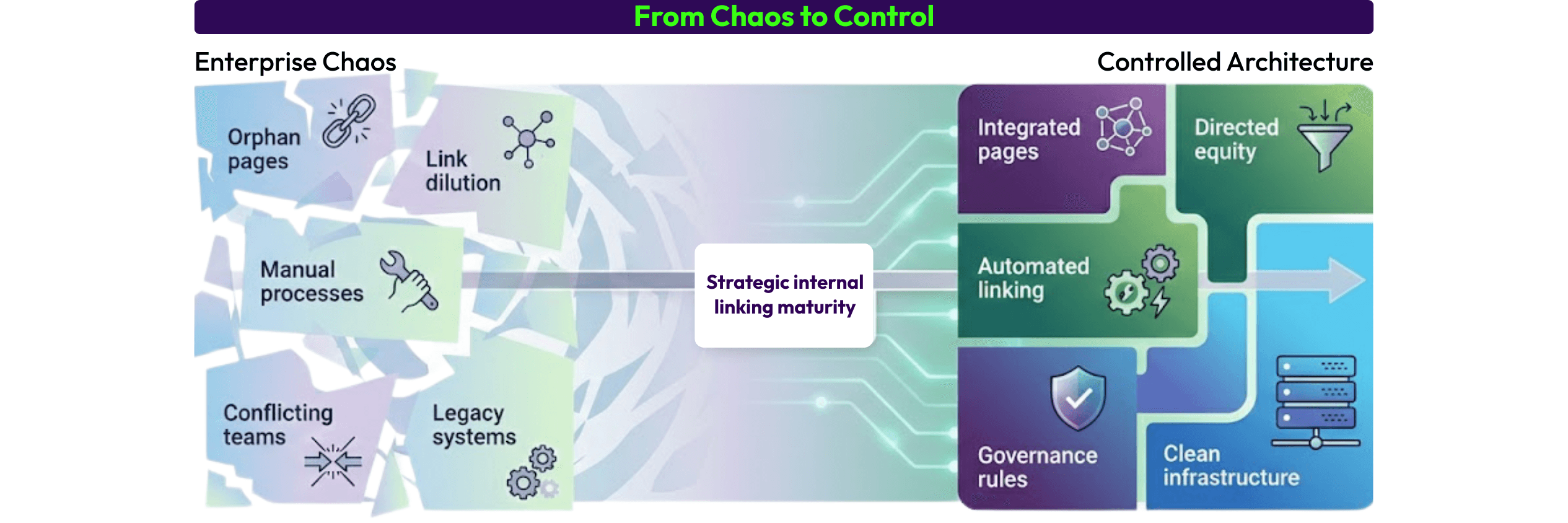
Enterprise internal linking faces unique obstacles that smaller sites don't encounter. Addressing these challenges separates successful implementations from failed attempts. Orphan pages represent a persistent problem for large sites. These pages have no internal links pointing to them, making them virtually invisible to search engines and users despite potentially valuable content. Enterprise sites average 30-70% orphan page rates, meaning the majority of content never contributes to organic performance. Systematic audits combining sitemap analysis with crawl data identify orphans, which you can then integrate through contextual links from related pages.
Scalability limitations affect many internal linking projects. What works for 1,000 pages may collapse at 100,000 pages. Technical implementations must account for database query optimization, API rate limits, and rendering performance. Cloud-based solutions with robust infrastructure handle enterprise scale better than plugin-based tools designed for smaller sites.
Content velocity creates constant linking opportunities and challenges. Enterprise sites publishing dozens or hundreds of pages daily need systems that identify linking opportunities in real-time and implement them without manual intervention. Integration between your CMS, automation platform, and content workflow ensures new pages don't become orphans.
Cross-departmental coordination becomes necessary when content teams, product teams, and technical SEO teams all influence internal linking. Establish clear governance frameworks that define who controls linking decisions for different page types, how conflicts are resolved, and what approval processes apply to automated systems.
Link equity dilution occurs when excessive navigation links, footer links, or templated links from every page create thousands of low-value links that waste the equity of high-authority pages. Audit these sitewide link patterns and consider whether each truly adds value or should be removed or nofollowed.
Technical debt from legacy systems, multiple CMS platforms, or complex internationalization setups can make implementing sophisticated internal linking difficult. Sometimes the highest-impact work involves cleaning up technical infrastructure before deploying advanced linking strategies.
Strategic internal linking represents one of the most powerful levers enterprise SEO teams can pull. Unlike external link building, which requires ongoing outreach and relationship management, internal linking is completely within your control. The initial investment in proper architecture, automation systems, and measurement frameworks pays continuous dividends as your site scales. The enterprises seeing the most dramatic results, traffic increases of 100% or more, share common characteristics: they treat internal linking as a strategic priority rather than an afterthought, they invest in automation appropriate to their scale, they measure rigorously and iterate based on data, and they maintain the discipline to enforce linking standards across all content creation. As search engines evolve toward semantic understanding and topic authority as ranking factors, the importance of strategic internal linking will only increase. Enterprise sites that master these advanced strategies today position themselves to dominate their competitive landscapes tomorrow.